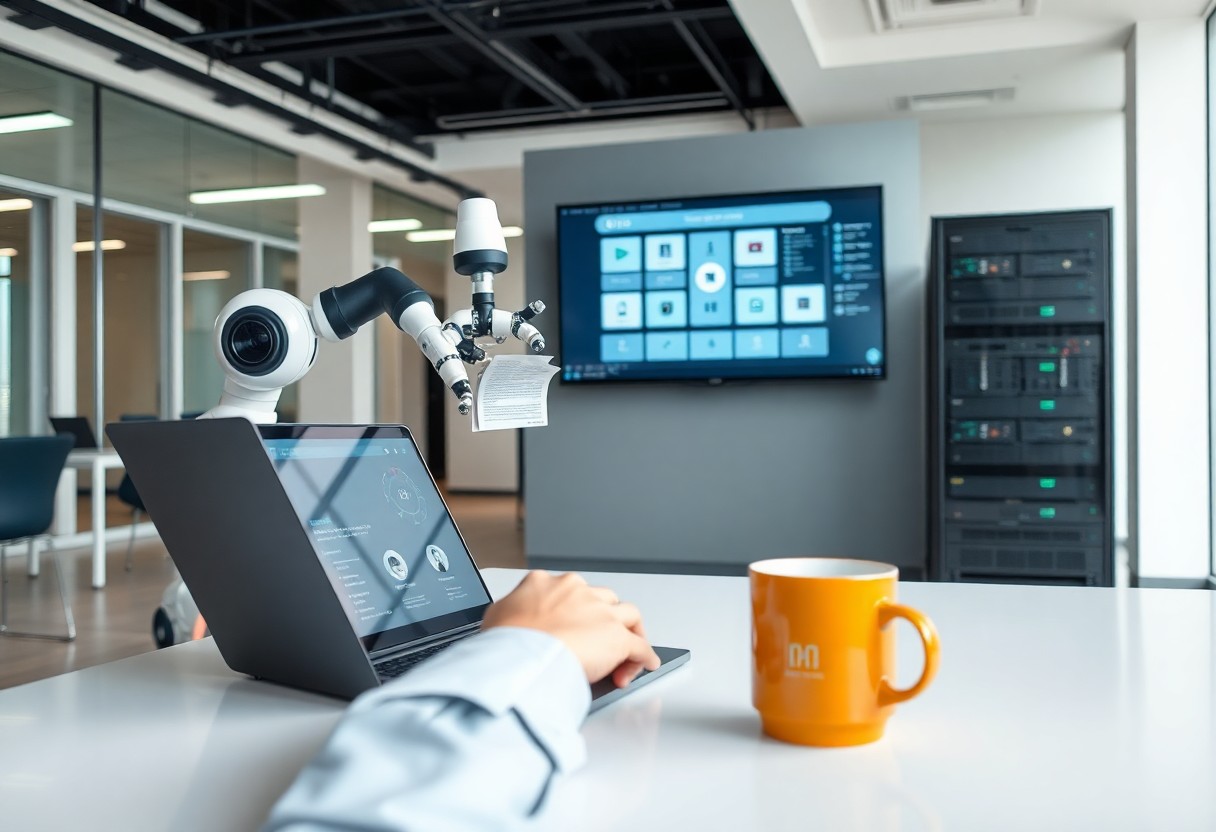
Most professionals today are already interacting with AI automation, whether they realize it or not. I see how routine tasks are disappearing, freeing you to focus on creative and strategic work. But I also warn you: job roles built on repetition are at serious risk. At the same time, productivity gains are real and measurable, reshaping your expectations of what work can look like.
Key Takeaways:
- AI automation is handling repetitive tasks like data entry, scheduling, and customer support, freeing employees to focus on creative and strategic work.
- Workflows are becoming faster and more accurate, as AI tools analyze large volumes of information in seconds and support real-time decision-making.
- Workers are adapting by building new skills in digital literacy and AI collaboration, shifting the demand toward roles that combine technical and human-centered abilities.
The Abolition of Manual Routine
I’ve watched entire job categories shift as repetitive tasks vanish into automated workflows. Data entry, invoice processing, and scheduling-once time sinks-are now handled in seconds. You no longer need to spend hours on predictable, rule-based work; AI handles it accurately and continuously.
What surprises most people is how quickly these changes scale. I’ve seen teams reclaim over 20 hours a week just by automating routine approvals and document sorting. This isn’t just efficiency-it’s a fundamental redefinition of the workday, freeing you to focus on decisions only humans can make.
The Liquidation of Clerical Drudgery
I used to dread the backlog of emails, forms, and follow-ups that piled up after every project. Now, AI sorts, responds, and routes them before I even open my inbox. Tasks that once demanded full-time clerical staff are completed silently in the background.
You might not notice the change at first, but over time, the burden lifts. I no longer feel chained to administrative noise. AI doesn’t just speed things up-it eliminates the drudgery entirely, letting you engage with work that actually matters.
Algorithmic Governance of Physical Labor
I’ve walked factory floors where robots adjust their movements in real time based on AI analysis. Sensors track every motion, optimizing workflows without human intervention. Physical labor is no longer governed solely by schedules or supervisors-it’s directed by algorithms.
You might think this only applies to manufacturing, but I’ve seen it in warehouses, farms, and even construction. Machines learn the most efficient paths, reduce waste, and operate around the clock. The human role shifts from doing to overseeing and correcting.
What strikes me most is how predictive algorithms now anticipate equipment failure before it happens. I’ve watched maintenance teams act on AI alerts days before a machine would have failed, avoiding costly downtime. This isn’t just automation-it’s a new layer of control where algorithms don’t just assist but actively govern physical operations, reshaping how you interact with machinery and environments. Safety improves, output rises, but the balance of control tilts toward the machine mind.
The Stratification of Intellectual Value
I’ve noticed a growing divide in how intellectual labor is valued in the age of AI. Tasks once considered skilled-like drafting reports or analyzing spreadsheets-are now automated, pushing their perceived worth downward. What was once a mark of expertise now risks becoming commoditized, accessible at the click of a button.
Human creativity and ethical judgment, however, are rising in demand. I see professionals who interpret AI outputs, challenge assumptions, and guide strategy being compensated more highly. This stratification means your ability to think critically now determines your economic standing more than technical execution.
The Primacy of Human Discernment
AI can generate insights, but it cannot decide which ones matter. I rely on my experience to assess context, intent, and consequence-something algorithms cannot replicate. Your judgment shapes whether automation serves progress or propagates error.
Every recommendation an AI produces requires scrutiny. I’ve seen flawed data lead to confident but dangerous conclusions. Only human oversight can detect nuance, bias, or ethical missteps hidden beneath clean outputs. Relying solely on automation without discernment is not efficiency-it’s surrender.
Technical Literacy as a Prerequisite for Survival
Understanding how AI systems function is no longer optional. I expect every professional to grasp basic data logic, model limitations, and automation workflows. Without this knowledge, you risk becoming irrelevant or, worse, manipulated by opaque systems.
Even non-technical roles now require fluency in digital tools and AI interfaces. I’ve watched colleagues lose influence because they couldn’t engage in conversations about the tools reshaping their departments. Technical literacy isn’t about coding-it’s about comprehension, control, and agency.
When I speak of technical literacy, I mean the ability to ask the right questions: Who trained this model? What data was used? How could it fail? These aren’t IT concerns-they’re survival skills. You don’t need to build the machine, but you must know how to question it. In meetings, decisions are increasingly driven by algorithmic suggestions; if you can’t dissect their logic, your voice will be silenced. I’ve seen it happen. That’s why I treat learning AI fundamentals not as upskilling, but as self-preservation.
The Acceleration of the Industrial Clock
I’ve watched workflows compress from weeks to hours, not through human effort alone, but through AI systems that operate without fatigue. Decisions once delayed by hierarchy now happen in milliseconds, reshaping how quickly products move from concept to market. You’re no longer racing against competitors-you’re racing against the clock they’ve already reset.
Eradicating the Friction of Thought
Thought used to stall at data overload, but now AI filters noise before it reaches your mind. I see teams making sharper calls because the mental load has been lifted. You don’t wrestle with spreadsheets-you receive insight, distilled and actionable, turning hesitation into clarity.
The Instantaneous Nature of Automated Choice
Choice happens before you even realize a decision point exists. I’ve seen procurement bots reorder supplies based on predictive demand, all without human input. These invisible decisions accumulate, quietly steering outcomes across departments you may not even oversee.
What surprises most people is how little they notice these choices until something goes off track. I realized last month that a pricing shift in our catalog was driven entirely by an algorithm reacting to regional sentiment data. You’re not just making faster decisions-you’re living inside a stream of them, many of which you didn’t know were being made.
The Erosion of the Traditional Career
I used to believe that hard work led to a clear career path-climb the ladder, earn promotions, stay with one company for decades. That model is fading fast, replaced by project-based roles and fluid job functions shaped by AI automation. You’re no longer on a straight trajectory; instead, your career resembles a web of shifting skills and temporary engagements. As machines handle routine tasks, employers value adaptability over tenure. For more insights, see What AI Means for the Future of Work | News.
The Rise of Fragmented Labor
Work no longer fits neatly into 9-to-5 roles. I see more people juggling freelance gigs, part-time contracts, and AI-managed micro-tasks across platforms. This fragmentation offers flexibility, but erodes job security and benefits. You might earn from five different sources in a month, yet lack health coverage or retirement plans. AI enables this shift by matching skills to tasks in real time, but leaves workers to manage instability on their own.
Re-evaluating the Worth of Creative Output
Art, writing, and design now flood digital spaces at unprecedented speed-much of it generated by AI. I’ve watched originality lose value as algorithms replicate styles in seconds. Your creative work competes with infinite machine-made content, making monetization harder. Clients expect faster delivery, often unaware or unconcerned about authenticity. The emotional weight behind human-made art risks being ignored in favor of efficiency.
What worries me most is how easily AI mimics personal expression. When a poem or illustration can be generated from a prompt, your unique voice becomes just another data point. I believe we must redefine what we value-not just speed or volume, but intention, context, and emotional truth in creative work.
The Authority of the Invisible Manager
I’ve watched teams adjust their behavior not because of a boss’s direct order, but due to silent algorithmic nudges embedded in workflow tools. These systems track pace, output, and response times, shaping conduct without a single spoken command. The real power lies in their invisibility-you follow the rules not because you’re told, but because you assume the system knows best.
Decisions once made by supervisors now emerge from dashboards and alerts, shifting authority from people to processes. You’re accountable to software that never sleeps, one that interprets productivity in rigid, quantifiable terms. This unseen manager doesn’t negotiate, empathize, or adapt-it simply measures.
Surveillance Through Performance Metrics
Every click, pause, and keystroke feeds into performance dashboards you’re expected to optimize. These metrics create a constant, low-grade pressure to perform, even when you’re unaware of which actions are being scored. The system watches silently, turning routine work into a stream of measurable outcomes.
You begin to self-correct, not because you’re failing, but because you sense the gaze of the algorithm. This subtle surveillance reshapes behavior more effectively than any manager’s oversight, making you complicit in your own monitoring. Over time, you stop questioning what’s tracked-and what’s being ignored.
The Objective Tyranny of Software Logic
Software treats every task as a solvable equation, stripping away context, nuance, and human judgment. What gets labeled “efficient” often ignores emotional labor, creativity, or long-term value. I’ve seen skilled workers penalized not for poor performance, but for working outside the system’s narrow definition of “correct.”
You start to conform, not because it’s better, but because deviation triggers alerts or slowdowns. The machine doesn’t punish you-it simply makes noncompliance inconvenient. Over time, you internalize its logic, mistaking rigidity for fairness.
What’s most dangerous about this tyranny is how reasonable it sounds: “The data doesn’t lie.” But I’ve learned that software logic favors speed over depth, visibility over value. When you’re judged solely by what can be measured, everything else-intuition, mentorship, reflection-quietly disappears from view. The system isn’t biased in the human sense; it’s indifferent, which is far more insidious.
Summing up
Considering all points, I see AI automation reshaping your daily work in clear, practical ways. I’ve watched repetitive tasks fade into the background, giving you space to focus on decisions only humans can make. From routing IT requests to answering HR questions instantly, AI reduces delays and lets you move faster. You’re no longer slowed by bottlenecks that once required manual input. 5 Ways Artificial intelligence is Changing How We Work highlights real shifts already in motion across industries. I believe this isn’t about replacing you-it’s about refining how you engage with work.
FAQ
Q: How is AI automation changing everyday work tasks in offices?
A: AI automation handles repetitive tasks like data entry, scheduling, and email sorting, freeing employees to focus on creative and strategic work. Software powered by AI can process invoices, update records, and generate reports without human input. This reduces errors and speeds up operations. Workers now spend less time on routine chores and more time solving problems or engaging with customers. Many office roles are shifting from manual processing to overseeing and improving automated systems.
Q: Will AI automation replace human workers in most industries?
A: AI automation is transforming jobs, but it’s not replacing all human workers. It takes over predictable, rule-based tasks, especially in manufacturing, customer service, and data analysis. However, roles requiring empathy, judgment, or complex decision-making still depend on people. In many cases, AI works alongside employees, helping them be more productive. Some jobs will change or require new skills, but new roles in AI supervision, maintenance, and ethics are also emerging.
Q: What new skills do workers need to stay relevant with AI automation?
A: Workers benefit from learning how to interpret AI outputs, manage digital tools, and adapt to changing workflows. Skills like critical thinking, communication, and basic data literacy are more valuable than ever. Understanding how to train or correct AI models, even at a basic level, helps employees use these tools effectively. Employers are also looking for people who can collaborate across technical and non-technical teams, troubleshoot issues, and keep ethical concerns in mind when using automated systems.